Artificial Intelligence (AI) can improve fighter pilot performance and decrease the total time to train. Implementing unmanned AI platforms can decrease the demand for fighter pilots while Large Language Models (LLM) and Machine Learning (ML) can increase the supply of fighter pilots by reducing the duration of training. These technological innovations may offer a comprehensive solution to the fighter pilot shortage and improve overall training efficacy. More importantly, technology will keep the U.S. fighter pilot the most capable in the world.
The Fighter Pilot Shortage
To begin, it is helpful to understand the backdrop of the current fighter pilot shortage. The Air Force, as of October 2022, was short 1,907 pilots of which approximately 1,100 are fighter pilots. Similarly, the Navy is short about 100 fighter pilots. While the Navy is slightly healthier than the Air Force in total fighter pilots, the Navy has been plagued with issues with its advanced jet trainer, the T-45. This has caused a massive bottleneck in training, further worsened by a rocky start to the Naval Introductory Flight Evaluation program or NIFE. Shockingly, there are nearly 1,000 trainees waiting to start Navy flight training. This does not bode well for the near future of naval aviation.
To solve the problem of the fighter pilot shortage, you need to understand the lifestyle of a fighter pilot, and you need to understand the opportunities and incentives that surround a fighter pilot. While no fighter pilot wants war, they do train for many years to do a skill that is very rarely called upon. Fighter pilots want to be tested and valued. If not given a clear purpose, fighter pilots will likely leave the force. Concurrently, we have continued to strain the work-life balance of fighter pilots during peacetime. The rapid deployment cycles, extended deployments, and shortened tours at home put undue stress on family life. Furthermore, in the post-COVID era, airlines are hiring at a breakneck pace. This incentivizes many aviators to leave the service to get a job with a top airline making more money while also having an improved work-life balance. To top it off, the Navy and Air Force have an antiquated system requiring upwards of a 12-year service commitment to be a fighter pilot. The flexibility to change jobs has become the norm in the world today. Millennials change jobs on average every 2.8 years and Gen Z every 2.4 years. The Air Force requires a 10-year commitment post-training and the Navy requires an 8-year commitment post-training. This has disincentivized those who may be on the fence about joining the military to fly. The result of this is not enough bodies in seats and a strained force of fighter pilots.
The Ready Room
Society is in the midst of a Cambrian shift in how work is done and how to think about the value that a human provides in the workforce. OpenAI has been the first to expose the masses to the incredible leap in LLM technology with ChatGPT. While LLM's, or generative AI, may only be a probability-based prediction platform at their most fundamental level, they can transform the work done by instructors.
Generative AI has the potential to solve the dilemma of Bloom's 2 sigma problem. In the 1980s Benjamin Bloom ran a study comparing three different teaching methodologies: conventional learning, mastery learning, and direct tutoring. The conventional method was a 30:1 student-teacher ratio with a periodic exam. The mastery learning method also had a 30:1 ratio but included specific feedback after exams to fine-tune students' mistakes before moving to the next section. Lastly, the direct tutoring method combined the mastery learning technique, periodic exams, and a 1:1 student-teacher ratio. The results were striking. The direct tutoring group had a 98%, or 2 sigma, improvement over the control group.
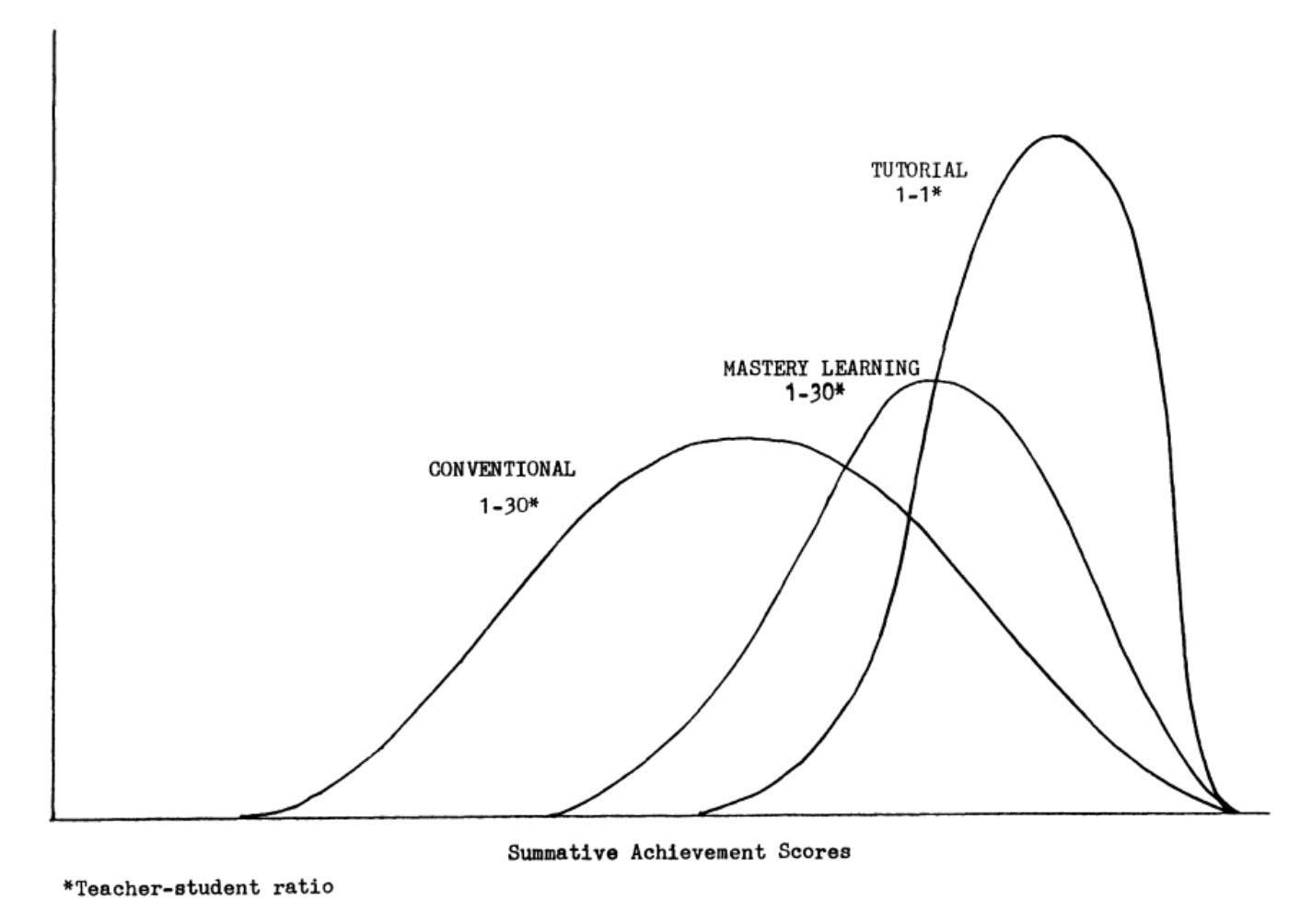
The results of Bloom's research are profound but do not solve the problem of scale. Requiring a tutor for every student is too manpower intensive in the military. Especially in the context of a community that is already short personnel. Smart software can close this gap partially. Legacy intelligent tutoring systems improved students' performance from the 50th percentile to the 75th percentile or a .66 standard deviation improvement. New breakthroughs in generative AI may be able to get us close to the 98th percentile. Some of the immediate benefits of generative AI would allow instructors to create content faster and iterate more rapidly. Over time, students will be able to ask the AI specific questions from their workstations without ever needing an instructor. The AI could be tailored to the curriculum to avoid factual errors that may arise. This system would take time and some oversight to begin, but would eventually allow students to have a personal virtual tutor with them at all times. Khan Academy is leading the way in this technology with Khanmigo.
Ultimately, freeing up instructors from teaching academics would allow instructors to focus on more important things like briefing, flying, and debriefing. This should decrease some of the supply-side issues in the training pipeline. With a great virtual tutor, we could see massive improvements in the outcome of student performance. This technology is still in its infancy but is improving quickly. There are already early versions of ChatGPT for CUI/FOUO information provided by the company AskSage. It is only a matter of time before we have a ChatGPT for Confidential/Secret/Top Secret material.
The Cockpit
Imagine you are flying a fifth-generation fighter jet with two Collaborative Combat Aircraft (CCA) to your flanks. The two drone wingmen will act as an intelligent and highly capable autonomous weapons system that is under your control. You are approaching the max range of a hostile surface-to-air threat. Instead of relying on your stealth to keep you safe, you deploy the two CCA's via voice command to your flight data computer with an 'attack' verbalized into your mask. The CCA's will then fly to their designated point in a stealth profile and each drop a 500lb precision bomb on the intended target before returning to your position. These smart CCA's will fly using technology similar to what is being developed by Shield AI. Now, imagine as those CCA's are returning to your position, you have an emergency. Your fuel system has noted an uncommanded dump of fuel from your main fuel tank. You have no procedure for this scenario. We are in the realm of what Nassim Taleb famously calls a 'Black Swan' event. We begin to climb and assess our systems while pointing back toward the aircraft carrier. The carrier, however, is 800 miles away. You begin to try and calculate the time distance problem based on your fuel burn and fuel remaining. Instead of doing this manually, you interface with the flight data computer that is connected to your tablet on your knee. You ask the system via voice command how quickly fuel is being vented from the aircraft. It responds with 1000 lb/min. Then you ask it to use the fuel burn rate and fuel vent rate to calculate an optimal flight profile toward the MQ-25 Stingray refueling aircraft. It immediately displays multiple adjusted bingo profiles you could fly to get the aircraft back to the MQ-25, highlighting the optimal profile. As the CCA's return to your position, you command them to perform a battle damage check on your aircraft. Using sophisticated machine vision, the CCA's note the damage to the underside of your aircraft and pass the imagery to your tablet on your knee.
This is not science fiction. Unmanned aircraft will be a part of the fighter pilot's future. They will not substitute the role of a fighter pilot, but instead, make the fighter pilot a force multiplier. The fighter pilot will act as the quarterback, making real-time decisions in the face of an unpredictable threat. Bringing more unmanned aircraft online should also decrease the demand for manned pilots. This will ultimately lower the demand-side requirement by alleviating the need for as many pilots while also making manned fighters much more lethal and survivable.
The Brief and Debrief
Fighter pilots have famously used thorough briefs and debriefs to prepare and learn from each flight. This has usually been preceded by advanced simulators and chair flying. Virtual reality is another technology that has progressed substantially and improved pilot performance. When not flying or using simulators, chair flying is a form of mental imagery practice that can also be useful. Chair flying involves deep visualization of the flight in detail. It is another way of flying before flying. In a meta-analysis of 141 research papers assessing the effect of mental imagery, 91.5% of them found a positive correlation in performance than those without mental imagery training. The proverbial baby does not need to be thrown out with the bathwater when it comes to revitalizing training. Fighter pilots should continue using tried and true methods like chair flying and incorporating red air tactics while simultaneously pushing for the latest technology. The training and repetitions in the simulator are fundamental to a fighter pilot's training. This will only become more important in the future as we will have fewer dedicated two-seat training platforms and more integration with unmanned systems.
The DARPA AlphaDogFight trials in 2020 showed the world that ML could develop tactics and win against the best humans in a virtual dogfight. The fighter community should develop new tactics with these technologies and incorporate them into training. In 2016, AlphaGo, an AI system built by DeepMind, defeated the best Go player in the world, Lee Sedol. At about the same time that AlphaGo defeated Lee Sedol, we see a correlation in the improvement of Go player's performance and novelty. The graph below is striking and reminds us that human intelligence can be improved by learning from AI. We should be using this same technology to make fighter pilots better and more lethal.
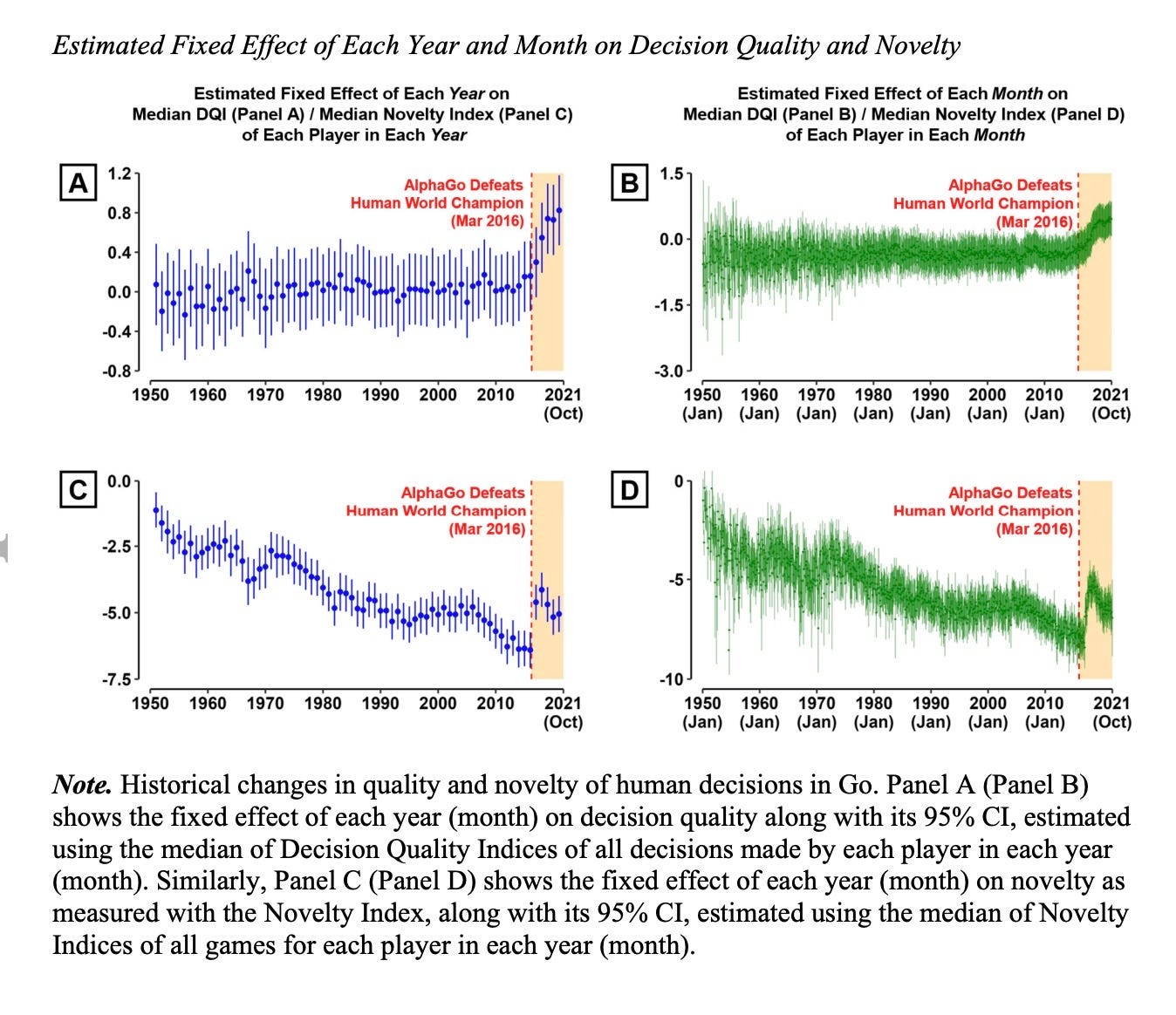
I will reiterate that I am not suggesting that future fighter pilots blindly follow the AI models. I suggest that fighter pilots improve their knowledge and decision-making by incorporating AI. We still need a human in the loop. Novelty and long-tail scenarios will arise in warfare and AI is nowhere close to Artificial General Intelligence (AGI). Just this year we saw a human being defeat one of the best Go AI systems by exploiting a glaring weakness in its play. Using a novel technique not used normally in Go, an unranked human was able to win 14 out of 15 games against one of the top machines. This is exactly what fighter pilots should be doing – using the latest AI systems to look for new and novel methods for tactical decision-making.
For a fighter pilot, the debrief is where most of the error recognition takes place. Debriefs can extend for many hours and cover every detail of the flight. Technology allows the fighter pilot to watch the flight in three dimensions. This data is provided to aircrew, but unfortunately never collected for review at a large scale. If the data were collected and analyzed over time, the fighter community could use ML and Reinforcement Learning with Human Feedback (RLHF) to assess and develop the optimal course of action in various tactical scenarios. Over time, this would allow instructors to grade students' maneuvers and weapons employment with a more objective eye. This would also allow instructors to immediately narrow their aperture on problem areas. This technology is available today, but we need to collect the valuable data that we use on every flight. Once data is collected, ML can find optimization profiles. This could also help train future capabilities of autonomous unmanned assets. Furthermore, with enough data, tactical trend analysis can be assessed. This detailed trend analysis could be compiled and individualized in a manner similar to athletes. Like a baseball card, each pilot could see their specific statistics and spot their weaknesses. This data would allow instructors to recognize problem areas and potentially reduce sunk costs from aviators who attrite late in training. Ultimately, this technology would increase pilot performance and decrease the total time to train.
Conclusion
In the evolving landscape of warfare, we must decide whether to embrace AI breakthroughs or risk falling behind. There are risks to embracing AI. The government will need to implement regulations as we go forward, but currently, we are not using AI or unmanned assets to the extent we should be. As John Boyd famously said, "You gotta challenge all assumptions. If you don't, what is doctrine on day one becomes dogma forever after." We need to challenge assumptions today and remove dogma from the fighter community. Unmanned platforms will not render the fighter pilot obsolete. In the Age of AI, a single fighter pilot's effectiveness could rival that of three or more. We need to have unmanned fighters flying alongside manned fighters and we need to be incorporating AI technologies into all phases of training to improve performance. We can decrease the demand for fighter pilots and increase the supply of fighter pilots by embracing the latest technologies. Having grown complacent over the last two decades, it is crucial for our nation to adapt swiftly and utilize every available technology to maintain our competitive edge.