The future seems more uncertain than ever. AI, political upheaval, institutional decay, and an uptick in global conflict. The combination of these feels unprecedented. You may feel paralyzed. This overwhelming "noise" can make decision making difficult. This becomes especially true when decisions are consequential and involve uncertainty or involve career pivots. The result is usually paralysis by analysis. I hate this problem. It can keep you from moving toward your best self. It can restrict action, which is required to excel in a rapidly changing world. Here is how I try to avoid it.
The OODA Loop
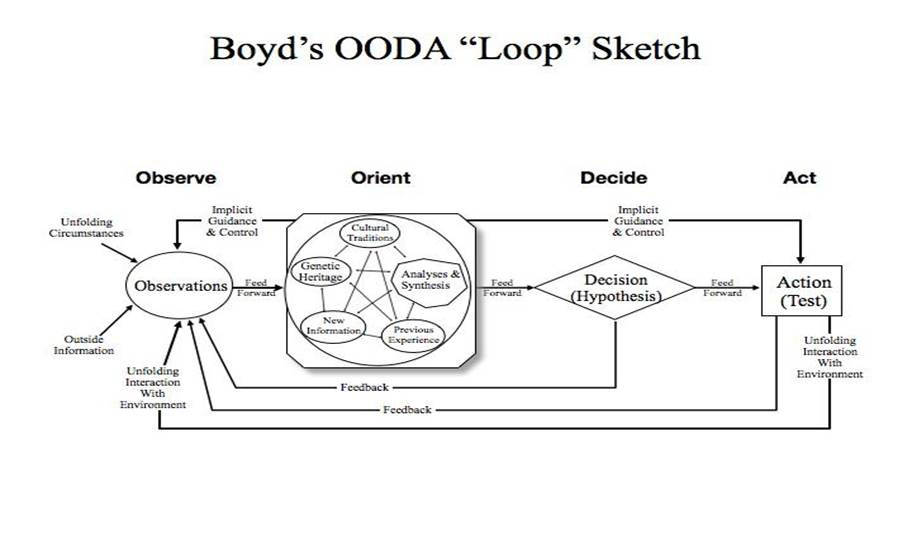
Created by Air Force fighter pilot John Boyd, the OODA loop is a simple decision framework that values speed and iteration to defeat an adversary. Boyd was known for defeating any adversary within 40 seconds. He was a member of the Air Force's Weapons School and was renowned for his dogfighting ability. He attributed this to his OODA loop. As an instructor pilot, I remember using the OODA loop to teach students decision making approaching every merge in a dogfight. It is the scientific method on speed. For example, young students in a dogfight will often plan before the merge occurs what they want to do with the jet without using real-time observational information from the threat aircraft. With repetitions and exposure, we can move through fast observation-feedback loops in the jet. These real-time observations of the adversary's state (whether that be energy state or positioning) allows us to more rapidly adjust our orientation in order to position our aircraft in the optimal place for follow-on maneuvering. This takes time.
At its core, the OODA loop is an understanding that our orientation, or preconceived notions, are our foundation. This orientation is based on our culture, experiences, values, genetics, and mental models that we use to make decisions. If you are unwilling to adjust your orientation, you will never adapt and win. The world gives us information every day that we can use to update our orientation. This updating is done through observation, and you can think of this as Bayesian updating. Our priors are updated as new information is received. These observations are essential in updating our orientation. AI may one day allow us to simulate, as close as possible, to the real world, various scenarios. However, I think AI will never exactly replicate the real world and therefore we have to act in the real world and observe the results of those actions and adjust accordingly. From our orientation, we can make a hypothesis. This hypothesis is an educated guess. For me, I just want to be about 70% sure I am right. With greater than 70%, I am willing to act. You won't always be able to get greater than 70%, but it's the goal. The action is the most important part of this entire loop. Without action, we can never get direct feedback. For me personally, this is also where I find out if I mean what I say. Until you must act, you won't feel the associated fear. As Rockefeller said, "Action solves everything." After the action takes place, we observe again (or collect data). This allows us to update our priors and reframe our orientation. This loop is continuous. The faster you can move through the loop and build feedback, the better. We will ignore trying to supplant our adversary's OODA loop as this is not applicable to our personal decision-making. In the end, the OODA loop is about:
- Knowing yourself
- Making an educated guess
- Action
- Updating through observation of that action
Simple but powerful.
Non-Linearity
In today's world, there is no linear path to career success. To thrive, we have to accept non-linear thinking. The mathematical definition of non-linearity is a relationship where the change in the output is not proportional to the change in the input. If you were to graph this relationship, it would form a curve rather than a straight line. The way I think of non-linearity in decision-making is looking for compounding opportunities. Non-linearity is the opposite of trading your time for money. If you are trading your time for money, i.e., you work on a salary and make an hourly wage, then you're on a linear career path. These career paths also can be more susceptible to disruption. We must be ready to pivot and adjust quickly. Non-linearity, to me, is associated with volatility. In the world of finance, volatility is risk. Without risk, however, there is no great reward.
For many, a safe job is comforting and appealing. The problem with this outlook is that it's linear and will result in average returns over a long period of time and trading your time for money. It could also put you in the crosshairs of AI and the impending massive changes to the job market. Warren Buffett is famous for saying that, "Diversification is protection against ignorance. It makes little sense if you know what you are doing." An investor who diversifies across the entire stock portfolio will see average returns. To generate alpha, you must sometimes look for focused bets. You must take a chance. When making decisions, if you always take the safe route, you will have average results. Therefore, look for outsized returns and non-linearity. Usually, these roles require taking on more risk, potentially lower salary with higher commission or equity. Either this, or the connections and relationships you can build in that resulting decision have the potential for non-linear returns later.
The other consideration when looking for non-linear outcomes is burning the bridges. For me personally, this is an important motivating factor. This could, for you, be a terrible idea, as it increases the risk and makes the decision more difficult and therefore a heavier burden to meet in order to act. For me personally, if I have optionality, I am less able to go all-in and push 100% day-in and day-out over a long period of time. If I have a backup, my effort will be lower. And the risk that I leave and go after the other route is higher. Therefore, for me, burning the bridges is the only way to reach my full potential. Remember the iconic story of Caesar crossing the Rubicon? He would say "Let the die be cast!" as he committed treason and risked his life and legacy crossing into Italy to fight.
Deadlines
Deadlines are perhaps the most important component of making decisions for me personally. There's nothing like a stress-induced deadline to get you to do something. As that deadline approaches, the stress will build. This will create tension, and the decision will weigh even more on you as the deadline approaches. You want to make the deadline stressful for yourself but give yourself enough time to gather as much information as is reasonably expected to get above that 70% threshold (ideally). Once you have this, you can make the decision early or wait for the deadline to make the decision.
If I don't impose deadlines, I will procrastinate and delay, waiting until I have as much information as possible. As we all know, this is impossible. I will never have full clarity; I will never know the outcome in its entirety. AI won't have the answers, and no one else will have the answers for me. At some point, you must go with your intuition and your logical assessment of the scenario, take a small risk, and act. Deadlines help us do this.
In summary, deadlines give us that push — the push to get uncomfortable and decide before we are fully ready. In this world, you will never be fully ready. You will never have all the information, and you will never know what tomorrow will bring. So, just start moving. If you're relentless in your pursuit, you will succeed.
Closing Thought
Using the OODA loop, nonlinear thinking, and deadlines will hopefully help you as much as they've helped me in my life so far. If paralysis by analysis is an issue for you and risk aversion frequently prevents you from deciding, then try to think through these three to get unstuck. Ultimately, life is far too short, and far too chaotic right now to dwell and analyze. You must move every single day toward that blurry goal post in the distance. Get off the sidelines and get going.